GetYourGuide4 h
Hurghada: Desert Quad Bike, ATV, Camel Ride & Optional BBQ
4.9 (3,798)
per personCheck dates
PlanPlan · Weather, heat and daylight
October, November and February are the easiest months for a desert trip from Hurghada: warm days, little dust and evenings you can sit through. From May to September you can still ride, but book a sunrise or sunset slot, never the midday one.
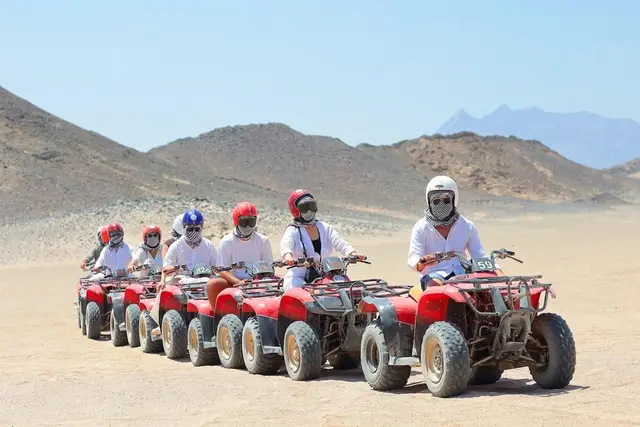
Safari Land quad stations
Updated 20 October 2026Facts checked against official and operator sourcesContains affiliate links
12 options · Prices checked on 20 October 2026
Nothing with those filters.
GetYourGuide4 h
4.9 (3,798)
per personCheck dates
GetYourGuide4.5 h
4.8 (2,398)
per personCheck dates
GetYourGuide4 hSahl Hasheesh
4.8 (2,057)
per personCheck dates
GetYourGuide4 h
4.3 (3,468)
per personCheck dates
GetYourGuide3.5 h
4.4 (2,915)
per personCheck dates
GetYourGuide3 h
4.9 (1,634)
per personCheck dates
GetYourGuideFull day
4.6 (2,198)
per personCheck dates
GetYourGuide2 h
4.7 (1,889)
per personCheck dates
GetYourGuide3.5 h
4.4 (2,214)
per personCheck dates
GetYourGuide2.5 h
4.9 (1,244)
per personCheck dates
GetYourGuide3 h
4.9 (1,169)
per personCheck dates
The best time to visit Hurghada for a quad or desert safari depends less on the month than on the hour you ride. The coast has sun almost every day of the year and rain on about one day, so the questions that matter are heat, dust and how cold the desert gets after dark. This page goes through Hurghada weather month by month from the point of view of someone sitting on a quad, then the daylight, the clock change and the stars.
One thing to know before reading any forecast: published Hurghada temperatures are measured at the airport, on the coast (the official climate normals used on this page come from that station). The camps where desert trips stop lie 15–35 km inland, beyond the safari stations of Safari Land on the Safaga road, and the weather there is different.
| Jan | Feb | Mar | Apr | May | Jun | Jul | Aug | Sep | Oct | Nov | Dec | |
|---|---|---|---|---|---|---|---|---|---|---|---|---|
| Midday quad ride | Best | Best | Good | Good | Poor | 0 | 0 | 0 | Poor | Good | Best | Best |
| Sunrise or sunset ride | Good | Good | Best | Good | Best | Good | Good | Good | Best | Best | Best | Good |
| Evening dinner and stars without a heavy coat | Poor | Poor | Good | Best | Best | Best | Best | Best | Best | Best | Good | Poor |
| Clear air, little blowing sand | Good | Good | Poor | Poor | Poor | Poor | Good | Good | Good | Best | Best | Best |
PoorGoodBest
If you can choose, October and November are the strongest months: warm, the least blowing sand of the year (2.7 days in October, 1.7 in November on average) and comfortable afternoons. February is a close second, with mild days and a little more dust. December and January are fine for riding at any hour; you only pay for them in the evening, when the desert gets properly cold.
March and April are warm and pleasant but are the dust season. May to September is hot, and in July and August very hot; trips still run every day, but the slot you book matters more than the operator.
For each type of trip, roughly:
| Jan | Feb | Mar | Apr | May | Jun | Jul | Aug | Sep | Oct | Nov | Dec | |
|---|---|---|---|---|---|---|---|---|---|---|---|---|
| High °C | 22 | 24 | 26 | 30 | 34 | 36 | 37 | 38 | 35 | 32 | 28 | 24 |
| Low °C | 12 | 12 | 15 | 19 | 23 | 26 | 28 | 28 | 26 | 22 | 18 | 13 |
| Sun h/day | 8.6 | 9.9 | 8.8 | 9.5 | 10.2 | 11.6 | 11.4 | 10.4 | 10.1 | 8.9 | 8.8 | 8.0 |
| Rainy days | 0.2 | 0.0 | 0.2 | 0.0 | 0.1 | 0.0 | 0.0 | 0.0 | 0.0 | 0.2 | 0.1 | 0.1 |
Source: WMO 1991–2020 normals, Hurghada (NOAA NCEI) ↗ · WMO 1961–1990 sunshine (NOAA, archived) ↗
These are the mild months. Average coastal highs run from 27.8 °C in November down to 22.2 °C in January, so a midday quad ride is pleasant rather than punishing. Blowing sand is at its lowest in November and December.
The catch is the evening. In the desert belt about 20 km inland, nights are about 4–5 °C colder than on the coast, and from December to February between half and three-quarters of nights fall to 10 °C or below. Sunset comes early too: around 16:54 in mid-November and mid-December, 17:13 in mid-January. On any sunset, dinner or stargazing trip in these months you will spend the last part outside in the dark and cold. Bring a fleece or jacket, not just a long-sleeved shirt; Scorpion Safari and BADU both tell guests to bring warm clothing.
Coastal highs climb from 26.2 °C in March to 29.9 °C in April, which is ideal riding weather. But these are the months of blowing sand: on average 7 days in March and 8 in April when wind lifts sand and lowers visibility. Germany's Foreign Office notes that sandstorms, the khamsin, come mainly in spring. The khamsin can also bring sudden heat: the coast station's April record is 41.3 °C.
Full sandstorms are rare, only about three days a year. What you get more often is a hazy, gritty afternoon, so goggles and a scarf over nose and mouth matter more now than in any other month. Check the wind forecast the day before; if it looks bad, ask your seller about moving the date.
October is warm (average high 32.1 °C) and among the clearest months. Sunset is around 18:17 in mid-October, until the clocks go back after the last Thursday of the month; overnight, sunset moves to about 17:00 and every sunset pick-up moves an hour earlier. If you are booking a sunset trip at the end of October, read the pick-up time on your confirmation, not on last month's reviews.
Hurghada in summer is hot by any standard. Average daily highs on the coast are 33.7 °C in May, 36.3 °C in June, 37.4 °C in July, 37.5 °C in August and 35.3 °C in September; nights stay at 23–28 °C. The coast station's record is 42.6 °C, set in June.
Inland it is hotter in the day. From May to September, afternoons in the desert belt run about 2–3 °C above the coast, and in July and August many afternoons at the camps are around or above 40 °C. There is little shade at a quad station or on the track, and a quad's engine adds its own heat.
So how hot is Hurghada in July for a desert trip? At midday, too hot for most people to enjoy. At sunrise and after sunset, perfectly manageable.
Trips run all summer. The trick is to ride when the sun is low.
Pick-up at your hotelAbout 60–90 minutes before sunrise; earlier from the outer resorts
Safari station: waiver, briefing and test driveBuy a scarf here if you forgot yours
Ride out as the sun comes upSunrise around 05:48 in mid-June
Camp stop: tea or breakfast, short camel rideBreakfast is an option on some listings
Ride back to the stationStill the coolest part of the day
Back at the hotelBefore the heat builds
Summer evenings have their own problem: the sky gets dark late. In June full darkness only arrives around 21:12, so a five-hour sunset-and-stars trip in summer gets you back around midnight, and a short sunset ride that is back at 21:00 never sees a truly dark sky.
GetYourGuide4 hMakadi Bay
4.7 (129)
per personCheck dates
GetYourGuide4 h
4.2 (152)
per personCheck dates
GetYourGuide2 h
4.2 (1,772)
per personCheck dates
GetYourGuide4 h
4.3 (3,468)
per personCheck dates
GetYourGuide4.5 h
4.7 (1,001)
per personCheck dates
GetYourGuide5 h
4.6 (503)
per personCheck dates
See everything on GetYourGuide →See everything on Headout →Prices checked on 20 October 2026
| Month | Morning-ride pick-up | Sunrise (15th) | Sunset (15th) | Sunset-ride pick-up |
|---|---|---|---|---|
| January | 05:06–05:36 | 06:36 | 17:13 | 14:13–15:13 |
| February | 04:51–05:21 | 06:21 | 17:37 | 14:37–15:37 |
| March | 04:23–04:53 | 05:53 | 17:54 | 14:54–15:54 |
| April | 03:49–04:19 | 05:19 | 18:10 | 15:10–16:10 |
| May | 04:26–04:56 | 05:56 | 19:26 | 16:26–17:26 |
| June | 04:20–04:50 | 05:50 | 19:41 | 16:41–17:41 |
| July | 04:30–05:00 | 06:00 | 19:41 | 16:41–17:41 |
| August | 04:46–05:16 | 06:16 | 19:22 | 16:22–17:22 |
| September | 05:01–05:31 | 06:31 | 18:49 | 15:49–16:49 |
| October | 05:15–05:45 | 06:45 | 18:15 | 15:15–16:15 |
| November | 04:36–05:06 | 06:06 | 16:53 | 13:53–14:53 |
| December | 04:57–05:27 | 06:27 | 16:53 | 13:53–14:53 |
Egypt time: UTC+2, UTC+3 from the last Friday of April to the last Thursday of October. Pick-up windows are typical; your operator confirms the exact time.
Egypt uses summer time. Clocks go forward on the last Friday of April and back at the end of the last Thursday of October. In winter the country runs on UTC+2, in summer on UTC+3. The effect on desert trips is sudden: sunset jumps by an hour overnight, and sellers shift their sunset pick-ups with it.
Across the year, sunrise ranges from about 05:19 in mid-April (just before the clocks go forward) to about 06:43 in mid-October, and sunset from about 16:51 in early December to about 19:44 in early July.
Pick-up times follow the light, but not perfectly. Many sellers keep fixed clock times all year, which means a "15:00" afternoon ride in winter ends at sunset but in summer runs through the heat. Times are usually confirmed the day before by WhatsApp or e-mail: check them.
Night falls in stages. The sky is fully dark only about 75–90 minutes after sunset: around 18:14 in November and December, but not until 21:12 in June. For stars, the month matters less than the moon.
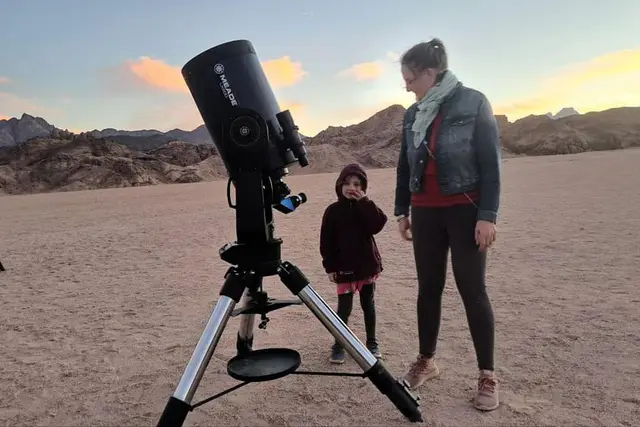
The big camps sit 15–35 km beyond the safari stations, well inland, so Hurghada's glow hangs low in the east, while the western sky over the mountains is dark; jeep trips that go deeper towards the mountains reach darker skies. Look for the word "telescope" or "astronomer" in the listing; "stargazing" on its own usually means looking up after dinner. The stargazing guide compares the trips.
Wind in Hurghada blows mostly from the north-west and north, at an average of 4.6–6.2 m/s depending on the month. In the desert that wind lifts sand. Over a year there are on average about 58 days of blowing sand, peaking in March and April, but only about three days of real dust storm.
Rain hardly figures: about one rainy day a year. The weather closures Hurghada does see are mostly at sea, when the ports close to boats. If a supplier does cancel a GetYourGuide booking for bad weather, the price is refunded under GetYourGuide's terms.
The basics never change: long trousers, closed shoes, a scarf and sunglasses or goggles. The season adds the rest.
| Season | Add to the bag |
|---|---|
| November to February | A fleece or jacket for any trip that ends after sunset |
| March and April | Goggles rather than sunglasses, and a scarf over nose and mouth |
| May to September | Extra water, sunscreen, the lightest long-sleeved top you have |
| Evening trips all year | A warm layer: the desert cools fast after dark |
The full kit list, plus safety, insurance and cash extras, is in the practical guide.
October and November are the strongest: warm days, the least blowing sand of the year and pleasant evenings. February is a close second. December and January are fine by day but cold in the desert after dark.
The average daily high on the coast is 37.4 °C, and the desert inland runs a few degrees hotter in the afternoon, often around 40 °C at the camps. Book a sunrise or sunset ride rather than a midday one.
Yes, trips run every day. Choose a sunrise slot (pick-up around 04:15–04:45 from a Hurghada hotel in June) or a sunset slot, drink plenty of water and avoid super safaris that put you on the quad around midday.
Mild by day, with an average coastal high of 23.8 °C and a low of 13.4 °C. In the desert nights are colder still and often fall to 10 °C or below, and sunset is around 16:54, so evening trips end in the cold dark.
March and April, with an average of 7–8 days of blowing sand a month. Full sandstorms are rare, about three days a year. Wear goggles and a scarf in spring.
Hardly ever. The airport records about one rainy day a year, so rain is not a reason to pick one month over another.
Booking calendars Our pages show live calendars from GetYourGuide, which may set cookies. You can load them automatically or only when you click. Cookie policy